
'In the struggle India is going through, the US must be seen very clearly as being in India's corner. Pakistani-based terrorism is not a problem that India faces alone. It's part of a common problem that the US faces as well,' says India expert Ashley Tellis.

Transition sources said Trump is close to selecting 55-year-old Tellis to be the next US envoy to India to replace Richard Verma who was appointed US Ambassador to India by outgoing President Barack Obama in 2015.
Burns said, "What is paramount to any agreement is a country's obligations to its own laws, and so we have preserved -- as we must -- our obligations under US laws in this agreement."
Ashley Tellis denies saying that the US 'got more from the government of Dr Manmohan Singh.' rediff stands by the interview.
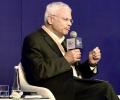
According to the Justice Department, Tellis, 64, the Tata Chair for Strategic Affairs and a senior fellow at the Carnegie Endowment think-tank, served as an unpaid senior adviser to the State Department and was also a contractor with the Office of Net Assessment at the Department of Defense.

'There are times when India should stand up without hesitation and voice its indignation over the US' pressure tactic. This is one such moment,' asserts Ambassador M K Bhadrakumar.

Possible US envoy says India must get assurance against China.
Noted strategic affairs expert Ashley Tellis, who was actively involved in negotiating the India-United States civilian nuclear agreement while serving in the George W Bush administration, has said the US is indispensable for the success of all of India's endeavours. Prime Minister Manmohan Singh is fully cognisant of this reality and this explains his unshakeable commitment to the India-US strategic partnership, he said.
Final part of the lecture given by Mumbai-born security expert Ashley Tellis at the National Defence University's Programme on Irregular Warfare and Special Operations Studies on the grave threat posed by the Lashkar-e-Tayiba to the world.
Third part of the lecture given by Mumbai-born security expert Ashley Tellis at the National Defence University's Programme on Irregular Warfare and Special Operations Studies on the grave threat posed by the Lashkar-e-Tayiba to the world.
Second part of the lecture given by Mumbai-born security expert Ashley Tellis at the National Defence University's Programme on Irregular Warfare and Special Operations Studies on the grave threat posed by the Lashkar-e-Tayiba to the world.
Though the international community first began taking notice of the terrorist group Lashkar-e-Tayiba after its spectacular coordinated bombing and shooting attacks in Mumbai, India, in November 2008, the group was established in 1987 at a time when Pakistan was in the throes of Islamic ferment.
Ashley Tellis, a former official in the George W Bush administration and key foreign policy adviser to Republican presidential candidate Senator John McCain, had initially been a sceptic of the (United States President Barack) Obama administration's policy toward South Asia and specifically India.
Strategic affairs specialist Ashley Tellis believes the November 26 terror attacks on Mumbai has given birth to the "misguided notion" that a resolution of the Kashmir dispute is imperative to rein in terrorism in South Asia, and that this should be the priority of the proposed special envoy to the region.
The prize, comprising Rs one lakh, a plaque and an invitation to lecture in Delhi, will be awarded at a function to be held in April.
Irrespective of how the coming security transition in Afghanistan pans out, one country is on a surprising course to a major strategic defeat: Pakistan. Ashley Tellis analyses.
If the prime minister can show once more that he is capable of making difficult decisions, he could restore US-Indian ties to the earlier upward trajectory, believes Ashley Tellis.
Noting that China's potential sale of two nuclear reactors to Pakistan has created great unease in the international non-proliferation community, a leading American think-tank has urged the US to put pressure China to reverse course.
In his report released recently titled 'Dogfight! India's Medium Multi-Role Combat Aircraft Decision,' Ashley J Tellis -- Senior Associate with the Carnegie Endowment for International Peace -- pilloried the Russian aircraft saying it was the "weakest of the contenders" for the IAF's MMRCA deal.
"There has been increasing international pressure on Pakistan to break off this intimate relationship between the ISI and LeT, but it has thus far come to naught," Ashley Tellis, who is senior associate, South Asia Programme with the Carnegie Endowment for Peace, said in his latest policy outlook The Menace That Is Lashkar-e-Tayiba.
Terming the passing of the civil nuclear liability bill by the Parliament as 'flawed', an eminent American expert on South Asian affairs has said the US policy makers and industrial leaders have been taken off guard by this and it threatens to cast a pall over the historic Indo-US civilian nuclear deal.
'India has had seven years after the 1998 tests, what has it done on the weapons front?'

The author of a definitive guide to the Kashmir crisis speaks with Managing Editor Aziz Haniffa.
Leading South Asia experts have assured the United States Congress that the prospect of Pakistan's nuclear arsenal falling into fundamentalist hands is, at least in the short term, unlikely.

Terming United States President Barack Obama's maiden trip to India as a triumph, noted American experts cutting across ideological spectrum on Monday said that it has taken the Indo-US relationship to an altogether new level.
They rejected India signing a fissile material treaty or any such thing as a pre-condition for Congressional approval of the civilian nuclear deal, and said it could have negative consequences for both India and the United States.
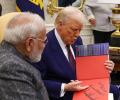
'The current strain in the relationship is serious and likely to be long lasting.' 'Even if Trump suddenly changes his attitude toward India -- which he is entirely capable of doing -- it is unlikely that New Delhi will be able to pick up the pieces and respond as if nothing has happened.'

'...it should not delude itself into thinking that India's security or its great-power ambitions will be advanced by those partnerships.'
'Instead, what India should focus on is on riding out the next three-and-a-half years of Trump's presidency with minimal damage to itself.'

'Fears in Washington began to intensify when it was realised that subsequent Pakistani and Indian attacks on major military facilities -- which were significant in terms of geographic scope and intensity -- could rapidly take both sides to where neither actually wanted to go.' 'The US objective was to stop the fighting as soon as possible. Everything else was secondary.'


Nuclear weapons in Pakistan's hands have "corrosively destabilising" effects in the region and provide a license for the country's sub-conventional wars against India, a top American expert has said.
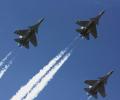
The report authored by Ashley Tellis, the top American expert on India and South Asia, states that the IAF's fighter force is weaker than numbers suggest.
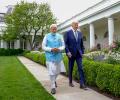
'India will want a lot of help from the US, but it's not going to want US troops.'
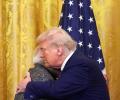
'He needs to see results while he is in office.'

The US president's remarks in this regard come days after senior Indian and Chinese military commanders held talks aimed at resolving the months-long standoff along the Line of Actual Control in Ladakh. The two countries agreed to stop sending more troops to their disputed border in the Himalayas.
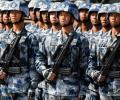
'The unfortunate truth is that China, having exploited the initiative to seize pieces of India's claimed territory, can now hold on to its new acquisitions forever unless India chooses to eject Chinese troops by force or decides to impose tit-for-tat costs on China by symmetrically occupying other pockets in disputed territory where it possesses a tactical advantage'
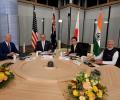
Saturday's Quad meeting in Delaware is taking place against the backdrop of China's assertive behaviour in the South China Sea, its sabre-rattling in the Taiwan Strait and increasing footprints in the Pacific and Indian Ocean, asserts Rup Narayan Das.
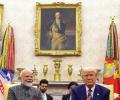
'Modi's intention was to create goodwill that will allow India to be seen by Trump as more than just a bad tariff problem.' 'He succeeded brilliantly on that count but none of these wins are unfortunately permanent.' 'Modi will have to do this again and again if Trump's grievances are to be durably assuaged.'

'He had to change them because he recognises that even with his popularity....could lead to a problem. So, democracy has this way of offering corrections and telling the ruling party or the prime minister that you need to take some steps to compensate for excesses'

The Indian position on the Russia-Ukraine war and the unconditional treaty between China and Russia appear to have caused some ripples in India-US relations and led to a reappraisal of India's usefulness to the US in the eventuality of a conflict with China, notes Ambassador T P Sreenivasan.
